
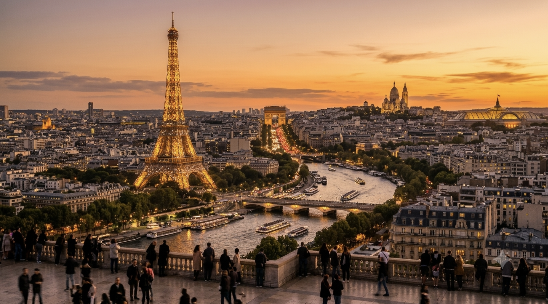
From the Eiffel Tower's new 2027 fares and the Louvre's two-tier pricing to the reopening of the Palais de la Découverte and the closure of Montparnasse Tower, Paris is changing fast. This research-backed 2027 guide covers the must-see attractions, up-to-date ticket costs, the smartest times to visit, transport passes worth buying, and a realistic three-day plan that avoids the queues and the rush.
Paris receives over 22 million international visitors a year, and its centre is compact enough to walk between many of its headline sights. That is both a blessing and a warning: you can see a lot in a short time, but only if you understand how ticketing, queues and opening days actually work in 2027. Several rules have changed recently — the Louvre and Versailles now charge non-European visitors more, the Eiffel Tower introduced new fares in January 2027, and Montparnasse Tower has closed for a multi-year renovation [4†L18-L27].
This guide is organised the way a first-time visitor actually moves through the city: the iconic skyline sights, the art museums, the islands and churches, the hilltop neighbourhood, and the day trip. Each section includes current 2027 prices, practical timing advice, and the one mistake most visitors make.
What’s New, Closed or Changing in 2027
Before you book anything, know what is actually open. The Montparnasse Tower Panoramic Observation Deck, closed since 31 March 2026, will remain inaccessible throughout 2027 for a complete redesign of the visitor experience [5†L7-L11]. The Centre Pompidou in Beaubourg is closed for renovation until 2030, though the new Centre Pompidou Francilien in Massy has opened as a partial substitute [5†L3-L6]. The Musée Nissim de Camondo also remains closed until 2030, and the Palais de Tokyo is due to close from November 2027 for 18 months [5†L12-L18].
On the positive side, the Palais de la Découverte, the historic science museum inside the Grand Palais, reopens in the first half of March 2027 after seven years of closure. The renovated space will span 8,000 square metres with eight exhibition galleries and a new 620-square-metre children’s area, focused on climate, AI, health and critical thinking [6†L5-L30] [8†L5-L26]. Also new for 2027: the Fondation Louis Vuitton will host a major exhibition of 164 works from The Broad museum from 21 April to 30 August 2027, and the Paris Expo Porte de Versailles will host a racket sports exhibition from 16–18 April 2027 [3†L11-L23].
The Iconic Skyline: Eiffel Tower & Arc de Triomphe
The Eiffel Tower remains the defining symbol of Paris. Built for the 1889 World’s Fair and standing 324 metres tall, it offers three distinct experiences: the glass floor on Level 1, the broad panorama from Level 2, and the summit at 276 metres. Summit lift tickets cost €36.70 for adults in 2026–27, while stairs to the second floor start at €14.80; ages 12–24 pay about half [0†L15-L19]. New fares took effect on 11 January 2027, and since September 2026 even stairs tickets must be booked in advance [4†L23-L26].
The best free view of the tower is not from the tower itself but from Place du Trocadéro across the river. Arrive about 30 minutes before sunset to watch the light change, and stay for the hourly sparkle after dark. Security lines are longest between 10am and 1pm; early morning or after 8pm are the quietest windows [4†L42-L44].
The Arc de Triomphe, a 15-minute walk up the Champs-Élysées, offers a different perspective: a 360-degree view over the twelve radiating avenues of the Étoile. From 1 April to 30 September, the rooftop costs €22 (€16 on Wednesdays); from 1 October to 31 March, it drops to €14.50 [11†L4-L11]. The critical practical detail: do not try to cross the traffic circle. Use the underground pedestrian passage from the Champs-Élysées side. Climb about an hour before sunset for both daylight and the city lights coming on [15†L85-L97].
The Eiffel Tower is best photographed from Trocadéro, and the Arc de Triomphe is best climbed at dusk. Doing both on the same evening is one of the great Paris sequences.
The Art Museums: Louvre, Orsay & Orangerie
The Louvre is the most-visited museum in the world, and its scale defeats most first-time visitors. Since January 2026, visitors from outside the European Economic Area pay €32 instead of €22 [4†L19-L22] [9†L4-L9]. It is open 9am–6pm but closed on Tuesdays, with late openings until 9:45pm on Wednesdays and Fridays [15†L67-L69]. A focused highlights visit takes two to three hours; trying to “do” the whole museum in one day is a recipe for exhaustion.
The smart strategy is to book the first time slot of the morning and enter through the Carrousel du Louvre entrance rather than the main pyramid, which is significantly less crowded. Head directly to the Denon Wing for the Mona Lisa (now in a dedicated viewing room), the Winged Victory of Samothrace, and French large-format painting, then add the Richelieu Wing for the Napoleon III apartments if energy remains [15†L52-L64].
The Musée d’Orsay, across the river, is the counterpoint: a converted railway station holding the world’s finest Impressionist collection, including Van Gogh, Monet and Renoir. It is closed on Mondays, open 9:30am–6pm (until 9:45pm on Thursdays), and general admission is €16 [12†L4-L10] [15†L72-L81]. Allow about three hours. The smaller Musée de l’Orangerie, in the Tuileries Garden, holds Monet’s Water Lilies in two oval rooms designed specifically for them. It pairs naturally with the Orsay: the walk between them along the Seine takes about 25 minutes.
Île de la Cité: Notre-Dame & Sainte-Chapelle
Notre-Dame reopened in December 2024 after the fire restoration, and in 2025 it became the most-visited monument in Paris, with around 11 million visitors — ahead of the Louvre and the Eiffel Tower. Entry to the cathedral is free. You can queue without a reservation, but a free timed reservation through the official website or app dramatically reduces waiting. Reservation slots are typically released only about a day or two in advance, not weeks ahead [13†L4-L8].
Five minutes’ walk away, Sainte-Chapelle is the hidden masterpiece most first-timers almost miss. Built by Louis IX in the 13th century to house religious relics, its upper chapel is almost entirely stained glass — 1,113 scenes across 15 windows. Tickets are €22 for non-EEA visitors and €16 for EEA nationals and residents as of January 2026, and timed entry is required [10†L6-L33]. Go in the morning when sunlight streams through the glass; the experience is far less impressive on a cloudy afternoon.
Notre-Dame is free but benefits from a reservation. Sainte-Chapelle costs money but rewards timing. Do both in one morning on Île de la Cité and you have seen two of the most important interiors in France.
Montmartre & Sacré-Cœur: The Hilltop Village
Montmartre sits on a hill in the 18th arrondissement and still feels like a village, with narrow cobbled streets, artists’ easels and sweeping rooftop views. The Sacré-Cœur Basilica is free to enter and open from 6am to 10:30pm, with the dome offering one of the best panoramas in Paris. Arrive early in the morning for quiet, or climb the steps before sunset to watch the city turn gold [17†L120-L136].
The classic route is Sacré-Cœur → Place du Tertre → Mur des Je t’aime → Rue de l’Abreuvoir, which takes three to five hours at a relaxed pace and is entirely free. Place du Tertre is crowded and the portrait artists can be pushy, but a quick walk through is part of the experience. The nearby Rue de l’Abreuvoir is the Instagram-famous curved street with the pink restaurant La Maison Rose at the top. A practical warning: the area has a high concentration of street sellers and “friendship bracelet” scams near the basilica steps. Keep bags zipped and ignore unsolicited approaches [17†L128-L130].
Versailles: The Day Trip That Needs Its Own Day
The Palace of Versailles is the most ambitious day trip from Paris: a 2,300-room palace, the Hall of Mirrors, and gardens that stretch to the horizon. Doing it properly takes six to eight hours door to door from central Paris. The Passport ticket, covering the Palace, Gardens and the Estate of Trianon, costs €35 in high season (April–October) for non-EEA visitors and €25 in low season (November–March); EEA residents pay less [14†L8-L31].
The easiest route is the RER C train from central Paris, which takes about 40 minutes. Versailles is closed on Mondays, so plan around that. Book a timed slot for the palace in advance and leave time for the gardens — many visitors rush the palace and skip the outdoor estate, which is arguably the more impressive half. A smart trick: go against the flow. Spend the morning in the gardens and Marie Antoinette’s estate at Trianon, then enter the palace after 3pm, when the Hall of Mirrors is far less packed [16†L154-L162].
Practical Planning: Tickets, Transport & a 3-Day Route
| Attraction | 2027 Price (non-EEA) | Closed | Key Tip |
|---|---|---|---|
| Eiffel Tower (summit lift) | €36.70 adult | Open daily | Book 60 days ahead; Trocadéro is the free view |
| Louvre | €32 non-EEA / €22 EEA | Tuesdays | First morning slot; Carrousel entrance |
| Musée d’Orsay | €16 | Mondays | Thursday late opening; 5th floor Impressionists first |
| Notre-Dame | Free | Open daily | Free reservation released ~1–2 days ahead |
| Sainte-Chapelle | €22 non-EEA / €16 EEA | Open daily | Go in the morning for stained glass |
| Arc de Triomphe | €22 (Apr–Sep); €14.50 (Oct–Mar) | Open daily | Underpass entry; climb at dusk |
| Sacré-Cœur | Free | Open daily | Early morning or sunset; watch for scams |
| Versailles (Passport) | €35 high season; €25 low season | Mondays | RER C; gardens first, palace after 3pm |
| Palais de la Découverte | Check on reopening | Reopens March 2027 | New science museum inside Grand Palais |
On transport, the Navigo monthly pass is set to rise from €90.80 to €93.40 in 2027, and the annual pass will exceed €1,000 (€1,027.80). A single metro-RER ticket rises slightly to €2.62 [7†L7-L38]. If you are staying four days or more, the Navigo weekly pass (around €30–€32 for all zones) remains the best value, covering metro, RER, bus and tram from Monday to Sunday. For shorter stays, a book of ten single tickets (a carnet) is cheaper than buying singles individually. Paper tickets are being phased out, so load tickets onto a Navigo Easy card or use the Île-de-France Mobilités app.
The Paris Museum Pass (2-day around €85, 4-day around €105) can save money if you plan to visit several museums in a short window, but it does not include transport and does not exempt you from booking timed slots at the Louvre, Orsay or Versailles. Do the arithmetic against your actual list before buying.
A realistic three-day route for 2027
- Day 1 — Icons: Morning at the Eiffel Tower (booked slot), walk to Trocadéro for photos, afternoon stroll up the Champs-Élysées, Arc de Triomphe rooftop at dusk, evening Seine cruise.
- Day 2 — Art & islands: First-morning Louvre slot (Denon Wing focus), walk through Tuileries to the Orangerie, then Notre-Dame and Sainte-Chapelle on Île de la Cité. End with a walk through the Latin Quarter.
- Day 3 — Montmartre & something new: Early Sacré-Cœur, wander Montmartre and Rue de l’Abreuvoir, afternoon at the newly reopened Palais de la Découverte (if open), final evening watching the Eiffel Tower sparkle from a bridge.
Paris rewards slow travel. The city is compact enough to walk between clusters, and the best moments often happen between the landmarks — a bench in the Tuileries, a croissant on a Montmartre step, the Seine turning gold at sunset.
The attractions are why people come, but the rhythm of the city is why they return. Book the big-ticket items in advance, leave room for unplanned wandering, and do not try to see everything in one trip. Paris is not a checklist; it is a city best experienced in layers.
Login with