
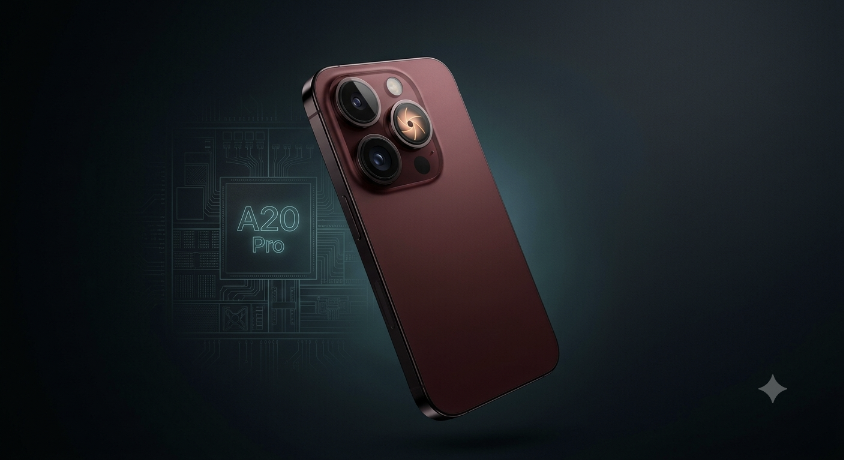
The iPhone 18 Pro Max is Apple's most significant "S-year" upgrade in recent memory. It brings the industry's first 2nm smartphone chip, a mechanically variable aperture camera, a dramatically smaller Dynamic Island, and the largest battery jump in Pro Max history. Here is a deep, research-backed look at the design, display, A20 Pro performance, camera system, battery life, iOS 27, and whether it is worth the $1,299 starting price.
Every few years, Apple stops refining and starts re-engineering. The iPhone 18 Pro Max is one of those moments. Announced on September 9, 2026, at the "Surprise and Shine" event, it arrives with a 2-nanometer A20 Pro chip, a camera that physically changes its aperture like a DSLR lens, and a battery that Apple says delivers the biggest endurance gain in the product's history. It is not a radical redesign on the outside, but underneath the familiar titanium-and-glass shell, almost everything that matters has been rebuilt.
This article breaks down the iPhone 18 Pro Max the way a spec sheet cannot: what each upgrade actually means, how it compares to the iPhone 17 Pro Max, and where the compromises still sit. If you are deciding whether to upgrade, or simply want to understand why 2026 is an inflection point for the iPhone, this is the deep dive you need.
Design and Display: Same Shell, Smaller Island
The iPhone 18 Pro Max looks almost identical to the iPhone 17 Pro Max at first glance. The dimensions are effectively unchanged: 163.4 × 78 × 8.8 mm, with the same 6.9-inch flat-edge design and Ceramic Shield 2 front glass. The visible change is the Dynamic Island, which Apple has shrunk by roughly 35 percent by moving parts of the Face ID system beneath the display. It can now display up to three Live Activities at once while taking up less screen real estate, which makes video and games feel slightly less interrupted.
The colour story is a bigger departure. Apple has retired the Cosmic Orange, Deep Blue and Silver of the 17 Pro generation and replaced them with four finishes: Black, Silver, Glacier (a pale, airy blue) and Burgundy, a deep purplish-red that has become the signature shade of the lineup. The Burgundy finish uses colour-matched glass and aluminium for a seamless look, and it is the option most likely to be recognised as "the new one" in public.
The display itself is the same 6.9-inch Super Retina XDR OLED with 1–120Hz ProMotion and a peak brightness of 3,000 nits. That is still one of the best panels on any phone, and the lack of a brightness bump is a reminder that the 17 Pro Max's screen was already excellent. The meaningful upgrade is not the panel itself but the smaller cutout and the under-display Face ID engineering that makes it possible.
Weight is the one design compromise. The 18 Pro Max tips the scales at 249 grams, up from 231 grams on the 17 Pro Max — an 18-gram increase despite the identical dimensions. The extra mass comes from the larger battery and the new vapour chamber, and it is noticeable in the hand. If you found the 17 Pro Max already heavy, the 18 Pro Max does not solve that problem.
A20 Pro: The First 2nm iPhone Chip
The A20 Pro is the headline silicon. It is the first iPhone chip fabricated on TSMC's 2-nanometer (N2) process, and it is packaged using a wafer-level multi-chip module (WMCM) design inspired by Apple's M-series Mac chips. The practical result is a chip that is roughly 15 percent faster than the A19 Pro while drawing 25 to 30 percent less power under sustained loads.
The architecture includes a 6-core CPU, a 7-core GPU with Neural Accelerators, and a dual 16-core Neural Engine. Memory bandwidth has increased by 50 percent, and all storage tiers now come with 12GB of LPDDR6 RAM. For day-to-day use, that means Apple Intelligence features run more locally, 4K ProRes video exports finish faster, and high-refresh gaming holds its frame rate for longer before throttling.
Thermal design is the unsung upgrade. Apple has placed the silicon die adjacent to the system memory rather than stacked on top of it, removing memory from the primary heat path. That die connects to a redesigned vapour chamber with three times the surface area of the iPhone 17 Pro's cooling system, which Apple credits with up to a 40 percent improvement in sustained performance. In plain terms: the 18 Pro Max is not just faster in a benchmark for 30 seconds — it stays faster for longer.
The A20 Pro is less about a single peak-speed number and more about endurance: it holds performance under load, and it does so while sipping less power.
Camera System: A Variable Aperture That Actually Matters
The camera is the most tangible upgrade. The 48MP Fusion Main camera now has a mechanical variable aperture — six laser-cut blades that open and close to change the amount of light reaching the sensor, just like a traditional camera lens. The aperture ranges from f/1.48 at its widest to f/4.0 at its narrowest, with four preset stops: f/1.48, f/1.8, f/2.8 and f/4.0.
What does that actually change? At f/1.48, the sensor gathers roughly 50 percent more light than the previous fixed f/1.78 aperture, which improves low-light photos and reduces noise without relying entirely on computational stacking. At f/2.8 or f/4.0, depth of field increases, so group shots and landscapes stay sharp from front to back. And because the blades are physical, portrait-mode background blur is optical rather than purely software-generated, which looks more natural around hair and complex edges.
The rest of the rear array is a triple 48MP system:
- Main: 48MP Fusion, f/1.48–f/4.0 variable aperture, 24mm, second-generation sensor-shift OIS.
- Ultra-wide: 48MP, f/2.2, 13mm, 120° field of view, with reduced edge distortion.
- Telephoto: 48MP periscope, f/2.8, 100mm, 4x optical zoom (with 8x "optical-quality" zoom via sensor cropping).
The front camera is now 18MP with Center Stage and an f/1.9 aperture, a modest but welcome bump for selfies and video calls. Apple has also added "Apple Reference Image," a cryptographic signing system that watermarks sensor data at the pixel level so a photo can be verified as camera-captured rather than AI-generated — a quiet but important feature in an era of synthetic media.
Battery Life: The Biggest Jump in Pro Max History
Battery is where the 18 Pro Max makes its most convincing case. Apple claims up to 45 hours of video playback on eSIM-only models, compared with 37 hours on the iPhone 17 Pro Max — an eight-hour gain. The physical battery capacity has grown to 5,391mAh on nano-SIM models, up from roughly 4,823mAh on the 17 Pro Max.
Two things make that possible. First, the A20 Pro's 2nm process and the new C2 modem are significantly more efficient; the C2 modem alone uses 15 percent less energy than the C1X it replaces. Second, on eSIM-only variants, Apple has used the space freed up by removing the physical SIM tray to fit a larger
Login with